
The HHS reduction in force (RIF) last April is well-trodden territory at this point. Everything was kept tightly under wraps until the end of March, when leaks about infighting seeped from the cracks in the agency’s DOGE operation. Those of us who were culled still remember waking up to the RIF notices in our inboxes or swiping our badges to discover that they had been deactivated. Thousands of people out of work, with entire units swept away. Many had lost their jobs seemingly at random, with little to no explanation from the press release on the agency’s proposed “transformation.” The walk-backs and word salad explanations offered by the HHS Secretary only added to the speculation on the rushed and haphazard nature of the layoffs.
There are some answers in the FDA’s agency file submitted to the MSPB, provided in response to appeals filed by RIFed FDA employees. These “DOGE files,” generously shared by our AltFDA colleagues, provide a window into the goals of the HHS RIF for all of its operating divisions (OPDIVs), a hint at the rationale underlying some of the cuts, and a shocking revelation - that there was an additional RIF that was authorized on May 1, which thankfully never happened.
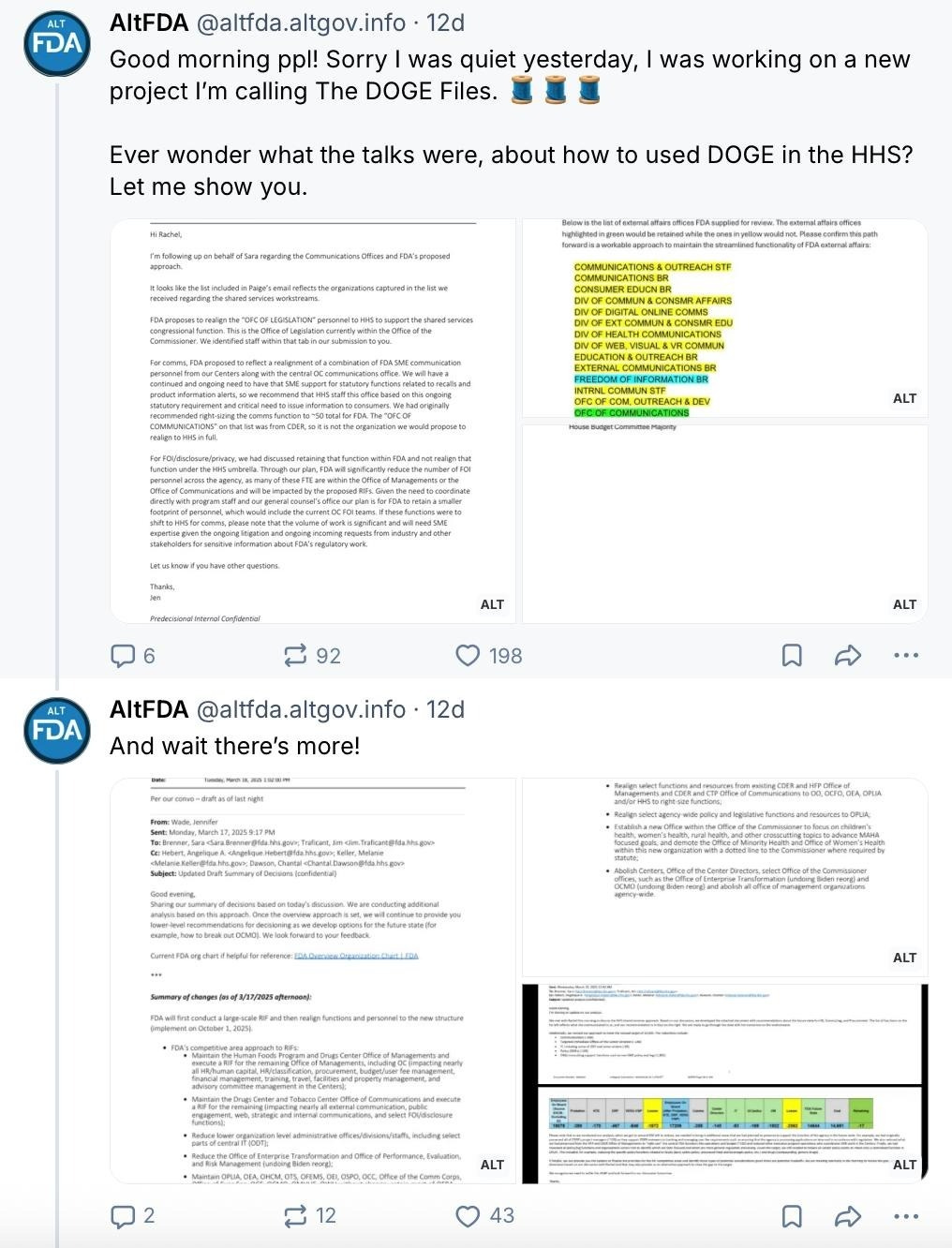
A sizable chunk of the agency file consists of the narrative response to the RIF appeals (which we will leave to the lawyers) and public proclamations from the administration, including the RIF executive order, OPM’s accompanying guidance, and the HHS reorganization communiqué. There are no major revelations there at this point, though it does state explicitly who the HHS-level decision-makers were:
Heather Flick Melanson: Chief of Staff to the Secretary
Scott Rowell: Deputy Chief of Staff for Operations and Assistant Secretary for Administration
Brad Smith: Senior Advisor to the Secretary (HHS DOGE lead who planned the HHS RIFs)
Rachel Riley: Senior Advisor to the Secretary (deputy to Brad Smith)
Thomas Nagy Jr.: Deputy Assistant Secretary for Human Resources
Shana Weir: Principal Deputy Assistant Secretary for Administration
Seth Shulman: Acting Director for the ASA Office of Human Resources Staffing, Recruitment and Operations Center
Garey Rice: CDC Budget Director on detail to HHS; supported Scott Rowell
Zachary Terrell: Senior Advisor to the Secretary (DOGE boy “yeoman“)
Clark Minor: HHS Chief Technology Officer
Some of the most interesting parts of this are the PowerPoint slides and emails between FDA, HHS, and OPM officials that show a two-week scramble to meet their desired headcount. The “Reorganization Priorities” slide deck is the perfect encapsulation of an approach to downsizing taken by someone who has no idea how a large government agency actually operates, but who thinks they do after looking at a few organizational charts. This is a person who needs no evidence to believe the oft-repeated, though repeatedly disproven, myth that the government is “inefficient” and “bloated,” who similarly believes the lie that private corporations conduct layoffs to “streamline operations” when they are actually intended to raise stock price. This also belies the reality that no one who worked for DOGE understood that federal agency budgets are set by Congress. The DOGE version of this Reagan-era fever dream of “downsizing government” set itself the following priorities:
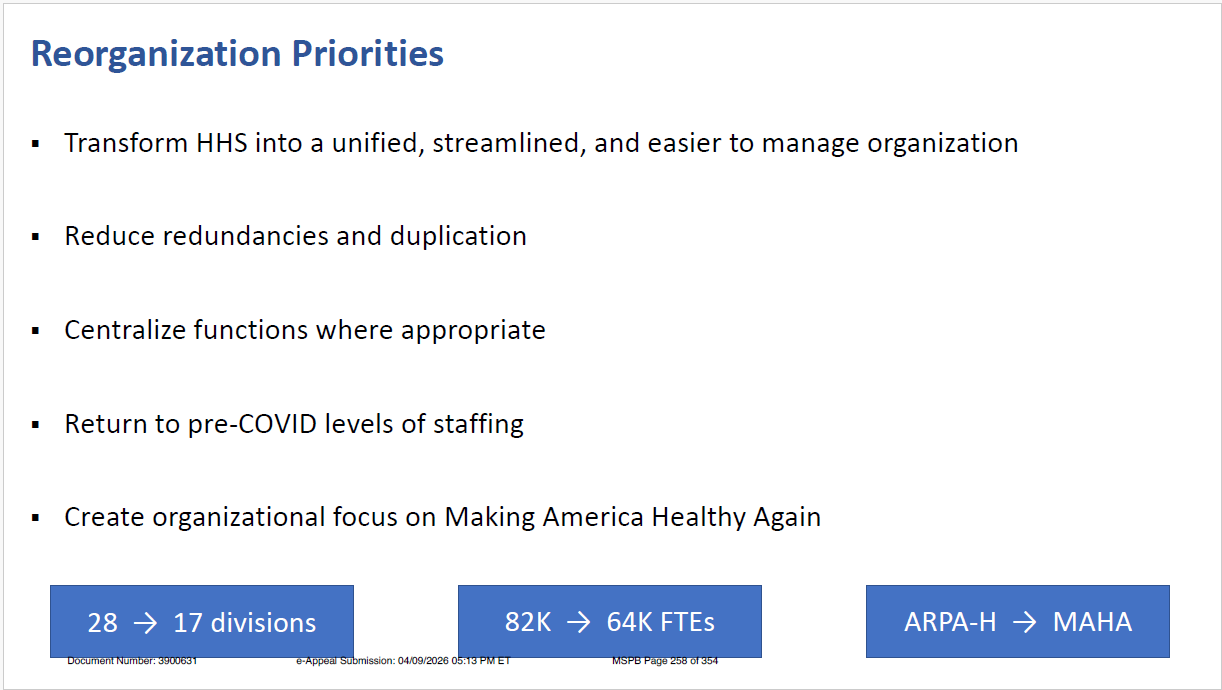
Note the fourth bullet, where we have added pandemic retribution as a modern feature.
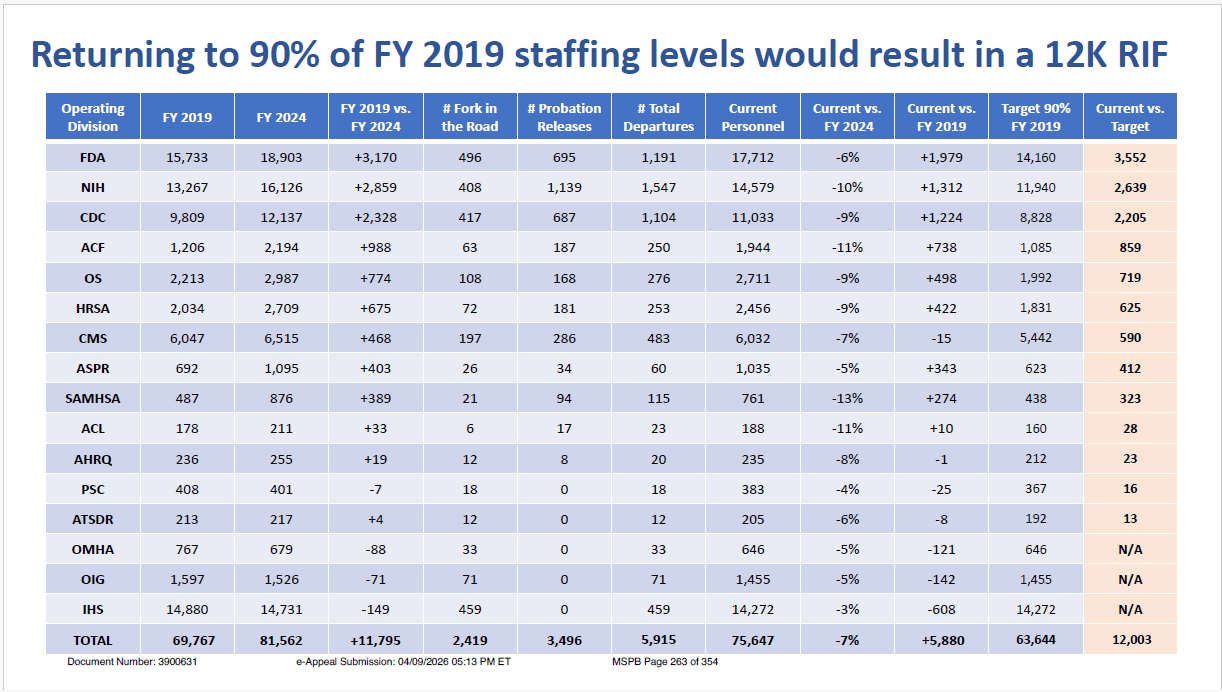
The goal to reduce staffing counts to 90% of FY19 levels is particularly jarring. This slide shows a comparison of FY24 to FY19 levels by OPDIV, targets for additional staffing cuts, as well as the number who took the “fork in the road” (less than 3%) and the number of probationary “releases.”
Based on the emails provided in the MSPB filing, the centralization of administrative functions was the initial focus of RIF planning. In a March 17 email, Rachel Riley identifies the functions being assessed, as well as the approach to identifying them:
Please find the spreadsheet discussed in the meeting today attached. By Wednesday COB, can you please:
1) Review Tab “OpDivOverview”, which summarizes every office and FTE count in your
division. Please mark an X in Column G to identify any offices that you think could be reduced / eliminated not already identified on the “Programs” tab.
2) Review the five tabs below and please denote whether to “Delete” an individual in
Column G if the FTE does other work in that area or “Add” an individual in Column G if an individual works in that area but is currently not listed on the tab; no action is needed if an employee is appropriately listed on a tab
a. Procurement (list based on all 1102 occs codes)
b. IT (list based on all 1530,1550,1560,2210 occs codes)*
c. HR (list based on all 201 and 203 occs codes)
d. External Affairs (list based on office names; may be less accurate)
e. Policy (list based on office names; may be less accurate)
f. Regions (all FTE whose duty station is coded as Boston, NYC, Chicago, Seattle, or San Francisco) - Please denote in Column H any employees who are either not actually located in the region or who perform a critical function and should not be included in any future reduction in force
Fun fact: the 1530 occupational series is for statisticians, and the 1560 series is for data scientists. These are scientists, not IT support positions. Additionally, while the 2210 series is titled “IT Specialist,” it includes statistical programmers who conduct analysis and data management to support statistical functions. This approach would have resulted in over half of the National Center for Health Statistics workforce being eliminated. This is what happens when you bring in consultants who know nothing about how an agency works and task them with eliminating “non-essential functions.”
A March 20 response goes into a bit more detail:
We’d (NIH, CDC, FDA along with HHS) envisioned the below – what has changed/is different from the plan now (partly summarized in your attachment)? Talking through may be faster... will find time to talk with you all this morning. TY!
The following functions could be centralized in a shared service model at the HHS level:
Ethics
Privacy
Freedom of Information
Records Management
Equal Employment Opportunity
HR: Employee and Labor Relations
HR: Training & Leadership Development, HR Operations (processing, benefits, retirements)
Reasonable Accommodation and Conflict Prevention Services
IRB → NIH services all
Publication subscriptions, library functions (e.g. Medscape, peer-reviewed journals, WebMD) → NIH services all
A few days later, Tom Nagy began sending spreadsheets of “competitive areas” to OPM for elimination. On March 25 at 10:27 PM, he sent an Excel attachment with nearly SAC codes across all of HHS. This list includes regional offices and units that appear to do policy, HR, procurement, and IT. At CDC, the list included the Office of Human Resources, the FOIA office, five of the six branches in the Office of Acquisition Services, communications, EEO, and a handful of units whose names include “information,” “informatics,” or “technology.” Then, a second email sent on March 26 at 10:53 PM includes a second spreadsheet with more than 100 additional SAC codes for CDC. These were cuts to scientific personnel, which Secretary Kennedy initially insisted did not happen, including almost all of the National Institute for Occupational Safety and Health; cuts to the Centers focused on injury, birth defects, and chronic disease; the Office of Health Equity, which includes the legally-mandated Offices of Minority Health and Women’s Health; the elimination of half of the Division of HIV Prevention, as well as the STD and viral hepatitis labs; the Division of Environmental Health Science and Practice, and half of the Division of Global HIV and Tuberculosis. Finally, the last 20 or so rows list codes for units at ACF, CDC, HRSA, NIH, OS, FDA, and SAMHSA with the terms “diversity,” “equity,” “inclusion,” “minority,” or “climate change.” This collection of over a thousand competitive areas was approved by OPM the next business day.
Then, on Saturday, March 29 at 1:40 PM, Nagy followed up with approximately 60 additional codes for units in ASPE, ACL, CDC, FDA, AHRQ, CMS, NIH, and ACF. These included regional offices and units that did communications and web design, plus a few more focused on policy, contracting, and workforce support functions. The response to this list came 25 minutes later:
Thomas- given that this request has come through on a weekend and is consistent with a methodology for defining competitive areas that OPM has approved in the past, and given what I understand to be the extremely time-sensitive nature of the request (i.e. you are planning to send the notices today), OPM is granting preliminary approval of the request. Formal approval from WPI will be forthcoming next week.
The following Monday, March 31, OPM confirmed that no RIF notices were sent out over the weekend and provided formal approval of the competitive areas submitted over the weekend. The RIF notices went out just after 5 a.m. on April 1.
Over the last 15 months, the fallout has been well-chronicled in the press. Immediately the agency realized that it had eliminated public health professionals performing essential functions, with Secretary Kennedy boldly asserting that it was “always the plan” to make mistakes and have to clean up a mess that was entirely avoidable. Reinstatements began almost immediately and continued over the following year. Meanwhile, the damage to essential functions, caused by these deep cuts to administrative support staff, persist. The backlog of reasonable accommodations requests, caused by the elimination of Equal Employment Opportunity staff across HHS, is estimated to include thousands of people. The skeleton crew that remains will take months to work through them. CDC’s emergency response capabilities are hamstrung by its inability to hire to fill empty positions. Unsurprisingly, HHS failed to heed a warning from Angel Hebert, FDA’s acting chief operating officer, that the downsizing effort would compromise agency operations. In an email sent at 5:34 AM on March 19, she sounded the alarm that the proposed cuts were likely to compromise FDA’s ability to accomplish its mission:
Sara and Jim it is important to note that we are concerned about the last 400 targeted to cut and are worried that the agency will not be able to function correctly under your leadership.
A new revelation to us from these files is a second planned RIF last spring. On May 1, Nagy sent a list of over 100 additional competitive areas proposed for elimination:
3 from HRSA
3 from ASPR
31 from NIH
7 from the Program Support Center
4 from the Office of the Secretary
62 from CDC
Yet again, the administration’s desire to specifically punish CDC stands out here. In contrast to the other units in the May 1 list, which appear to be primarily focused on communications, acquisitions and financial services, and HR, the proposed cuts to CDC would have eliminated offices of the director across the agency, including:
Every division director’s office in the following Centers:
National Center for Birth Defects and Developmental Disabilities
National Center for Immunization and Respiratory Diseases
National Center for Chronic Disease Prevention and Health Promotion
National Center for Environmental Health
Two of the three division director’s offices in the Center for State, Tribal, Local, and Territorial Public Health Infrastructure and Workforce
Two of the four division director’s offices in the National Center for HIV, Viral Hepatitis, STD, and Tuberculosis Prevention
Two of the three office director’s offices in the Agency for Toxic Substances and Disease Registry
Five of the seven division director’s offices in the National Center for Emerging and Zoonotic Infectious Diseases
The proposed cuts would have eliminated over 1,600 additional positions on top of the 2,400 lost in the April 1 RIF, cutting CDC’s total staff by a third. The only other OPDIV with substantial cuts proposed in this list is NIH, with 219 staff in the 31 proposed units.
Nothing in the agency file explains why the May 1 RIF was proposed, nor why it was never executed at CDC. We know that, by May, backlash to the initial cuts from Congress and the public was growing, which likely drove the early reinstatements. We know that HHS threatened to lay off an equivalent number of CDC staff to “offset” those reinstatements. We know that AFGE filed its motion for a temporary restraining order on May 1 to halt the large-scale RIFs across government, and that the State of New York filed its lawsuit a few days later. We have no email explaining what happened after OPM approved the May 1 list.
What we do know is that HHS has failed to accomplish every goal it set out with the RIF. The agency separated fewer than half of the employees it initially sent RIF notices to, and nearly half of those are appealing their terminations in the MSPB. Congress refused to authorize or fund its proposed reorganization in FY26 and looks poised to do so again in FY27. The agency’s current hiring plans put it on track to surpass the staff count at the beginning of the administration. All told, HHS has not saved any money and is less efficient than it was before.
Most importantly, it has not beaten CDC into submission. Those who have been fired are still fighting, and those who remain are still working. Despite being understaffed and overwhelmed, we remain steadfast in our duty to protect the public’s health. We remember our oath. We are holding the line.
Ooh fun, a RIF planner is deciding RAs.....that's an accident, right? 🥴